
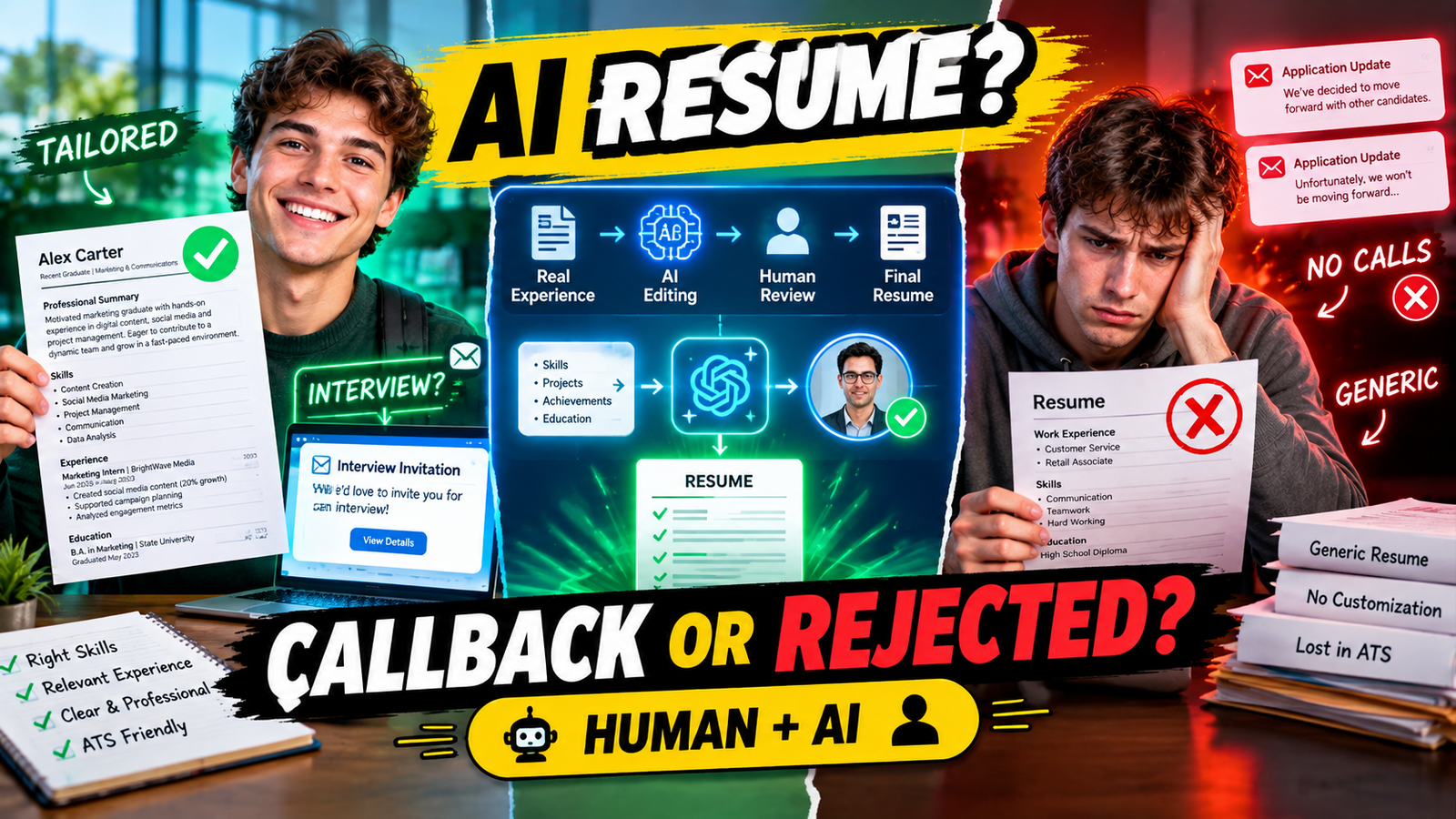
A good resume can help you get noticed and give you a better chance of reaching the interview stage. Today, AI can help you create, edit, and customize a resume much faster than you could do it manually with the help of Artificial Intelligence (AI).
Yet, a new challenge has also emerged: the prevalence of clichéd, keyword-stuffed resumes that lack a human touch. In this guide, you will learn how to use AI effectively while preserving the authenticity of your genuine skills and professional journey.
Key Takeaways
- Modern resumes effectively convey your work experience, capabilities, achievements, and skills to both human recruiters and digital hiring systems.
- Details provided in job descriptions, such as required skills, responsibilities, tools, and specific terminology – offer crucial cues for optimizing your resume.
- Presenting your achievements in bullet points is more impactful than listing generic job duties, as it clearly demonstrates what you have actually accomplished during your job.
- If you have the right information, AI can help you understand what the job description entails, improve your language, identify any gaps, and strengthen your resume.
- An ATS-friendly resume should feature clear headings, a readable format, a logical structure, and relevant keywords, while avoiding keyword stuffing.
- Human review of AI-generated resumes is essential, as AI can sometimes produce incorrect information or overly generic content.
- An excellent resume should be tailored to a specific position and contain an accurate description of your actual work experience.
What Is a Resume in the AI Era?
A modern resume is still a simple document that shows your experience, skills, achievements, and qualifications but now it may also be read by hiring software. A resume is no longer intended solely for human readers; it must also successfully pass the screening processes of online application systems and recruitment software.
In fact, LinkedIn reported in its 2025 Future of Recruiting research that 73% of talent acquisition professionals agreed AI would change how organizations hire – Source: LinkedIn, 2025.
That doesn’t mean you should write your resume only for software. Rather, it simply needs to be easy for hiring systems to read and easy for recruiters to understand.
You may also like this article :- Master the Perfect ChatGPT Prompt Formula
Why Is a Strong Resume Important in the AI Era?
A strong resume makes it easier for an employer to see how your experience fits the job. Recruiters may receive a large volume of applications; therefore, companies often use Applicant Tracking Systems (ATS) to sort and screen them.
LinkedIn found that 37% of recruiting organizations were actively integrating or experimenting with generative AI in its 2025 research, showing that AI-assisted recruitment was already becoming part of the hiring process. — Source: LinkedIn, 2025.
Furthermore, your resume should not merely be a collection of keywords lifted from the job description. If a job requires project management and you genuinely have experience managing projects, make that experience easy to find on your resume. If you haven’t used a particular piece of software, do not include it in your resume simply because AI suggested it, as this could lead to significant difficulties down the line.
You may also like this article :- How Professionals Are Using ChatGPT at Work (Real Examples)
How Do You Write a Resume in the AI Era Step by Step?
Start with the job you want. Then organize your experience, highlight your achievements, clean up the structure, and use AI to polish the final version.
1. Start With the Job Description
Before editing your resume, take a few minutes to understand what the employer is actually looking for. Pay close attention to the job title, required capabilities, desired skills, workload, tools used, qualifications, and frequently recurring terms.
For instance, if terms like paid advertising, Google Ads, analytics, and campaign optimization appear frequently in a marketing job description, you should pay attention to them—provided they align perfectly with your work experience.
2. Build a Career Information Bank
Next, collect your real career information before asking AI to write anything. Include:
- Previous jobs and responsibilities
- Achievements and measurable results
- Projects and internships
- Education and certifications
- Technical and industry skills
- Volunteer work and relevant side projects
This gives AI accurate material to work with instead of forcing it to guess.
3. Choose a Clear Resume Structure
After this, include sections such as a professional summary, work experience, skills, education, projects, and certifications, as required.
For candidates with a clear career trajectory, presenting information in chronological order is preferable. However, for those changing fields, freelancing, or possessing non-traditional experience, a skills-based or hybrid format may be more suitable.
4. Write a Strong Professional Summary
Instead of:
Hardworking professional looking for an opportunity to grow and develop my skills.
Try:
Marketing specialist with 4 years of experience managing paid social campaigns, email marketing, and content projects for B2B companies.
The second version quickly communicates who the person is, what they have done, and where their experience fits.
5. Turn Duties Into Achievements
A useful formula is:
Action + Task + Context + Result
For example:
Weak:
Responsible for managing social media accounts.
Stronger:
Managed LinkedIn and Instagram campaigns, increasing monthly engagement by 38% over six months.
Use only information that you can prove. AI should be used to improve your writing style, not to misrepresent your achievements.
6. Add Relevant Skills
Include details about your technical skills, software proficiency, industry knowledge, certifications, and practical work-related skills where relevant. You do not need to list every single skill mentioned in the job advertisement.
A recruiter should be able to understand your skills quickly without digging through a long list of buzzwords.
7. Make the Resume ATS-Friendly
An ATS-friendly resume features clear headings, a simple layout, a consistent structure, and precise, job-related terminology, rather than focusing merely on decorative elements.
Indeed recommends readable formatting, standard section labels, appropriate file types, and avoiding graphics, charts, photos, and overly complicated formatting for ATS-focused resumes. — Source: Indeed, 2026.
So keep your design simple. Follow the file format given by the employer and use key words naturally, do not repeat them unnecessarily.
You may also like this article :- Best AI Tools for Office Use In 2026
How Can AI Help You Write a Better Resume?
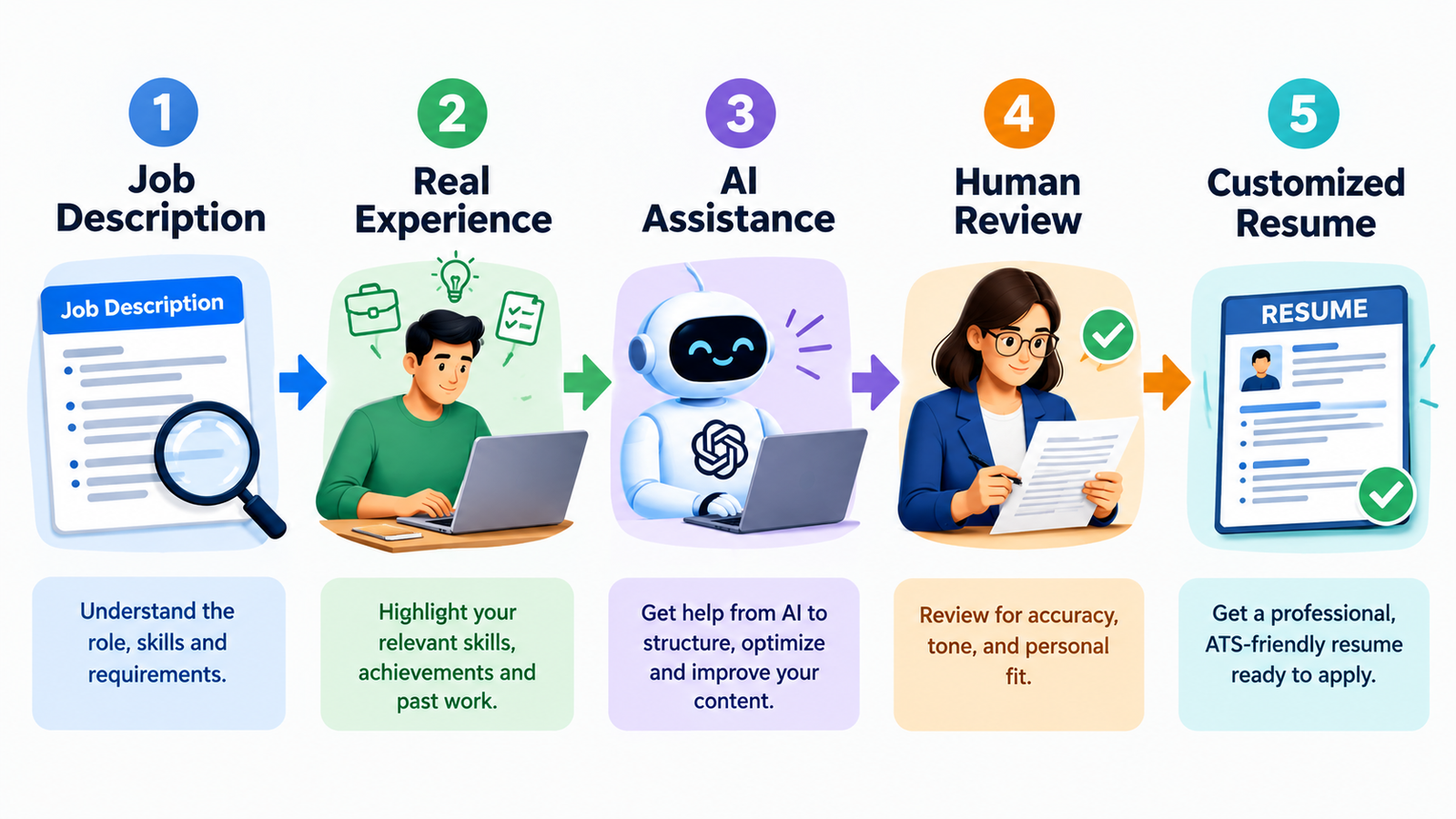
AI can assist in generating new ideas for your resume, improving it, understanding job descriptions, tailoring the content to specific needs, refining key points, identifying gaps, and correcting errors. OpenAI’s current career guide also suggests using ChatGPT to effectively showcase your experience, compare your qualifications against job postings, and draft impactful bullet points—though the responsibility for the final application remains with the individual.
For example, instead of asking:
“Write my resume.”
Give AI your actual experience and a target job description, then ask it to identify which parts are most relevant.
Follow this step:
Think of AI as your writing assistant, not the person making career decisions for you.
Useful ChatGPT Resume Prompts
Analyze a job description:
Analyze this job description and identify the most important responsibilities, required skills, preferred skills, tools, qualifications, and recurring keywords. Do not assume that I have any skill or experience that I have not provided.
Improve bullet points:
Rewrite these resume bullets to make them clearer and more achievement-focused. Preserve every fact exactly as provided. Do not invent metrics, responsibilities, tools, or achievements.
Customize a resume:
Compare my resume with this job description. Identify which parts of my experience are most relevant and which requirements are not clearly demonstrated. Suggest improvements without adding experience I do not have.
Proofread:
Proofread this resume for grammar, spelling, repetition, inconsistent dates, unclear wording, and formatting issues. Do not change any factual information.
OpenAI suggests that to get the best out of ChatGPT, you should provide clear instructions, explain necessary context, ask for precise results, and iterate for improvement.
You may also like this article :- How to Use AI to Save 10+ Hours Per Week at Work?
What Should You Never Let AI Do With Your Resume?
Never use AI to showcase experience, qualifications, capabilities, achievements, statistics, certificates, job titles, tenure (employment dates), or skills that you do not actually have.
This includes using AI to present a hypothetical project as professional experience, or claiming a 50% result instead of 10% because a “larger figure” looks more impressive in a resume.
Additionally, avoid sharing sensitive personal information when using AI tools. OpenAI’s career-readiness guidelines specifically advise users against entering sensitive information such as Social Security numbers, banking details, or personal documents into these tools.
The rule is simple:
AI should help you build a better resume, not invent a better career.
You may also like this article :- How to Use ChatGPT for College Essays
Which AI Tools Can Help With Resume Writing?
Various AI tools can assist at different stages of creating a resume. You can use AI chat assistants to generate new ideas and make improvements, resume builders for formatting, and grammar tools to correct errors.
You don’t need ten different AI tools. Choose one that solves the problem you actually have.
| Task | Example Tool | What It Helps With |
|---|---|---|
| Resume brainstorming | ChatGPT | Ideas and rewriting |
| Grammar | Grammarly | Grammar and clarity |
| Resume formatting | Resume builder | Layout and formatting |
| Job matching | AI assistant | Compare job description with resume |
What’s Next? Upgrade Your Resume With AI in 30 Minutes
You can make a big improvement to your resume in about 30 minutes if you focus on one specific job.
Minutes 1–5: Choose the target job and read the description.
Minutes 5–10: Identify important responsibilities, skills, tools, and terminology.
Minutes 10–15: Match those requirements with your genuine experience and achievements.
Minutes 15–20: Improve weak bullet points and remove vague language.
Minutes 20–25: Customize the summary and relevant skills.
Minutes 25–30: Proofread, verify every fact, and check the formatting and grammar.
Maintain a “master resume” that covers your entire work experience. This way, you won’t need to rewrite everything for every new job; instead, you can use that core document to create tailored resumes for specific positions.
You may also like this article :- Best AI Image Generator Free No Sign Up in 2026
AI-Era Resume Checklist Before You Apply
Before sending your resume, ensure that it is accurate and useful, easy to read, and tailored to the specific position that you are applying for.
- Is the target job clear?
- Does the summary match the role?
- Are relevant skills easy to find?
- Do your bullets show achievements?
- Are every number and date accurate?
- Are relevant keywords included naturally?
- Is the formatting simple and consistent?
- Did AI introduce any incorrect information?
- Does the resume still sound like you?
- Did you follow the employer’s application instructions?
A simple test: Read your AI-edited resume out loud. If a sentence sounds like something you would never say in an interview, rewrite it.
You may also like this article :- Best Free AI Writing Tools for Students 2026
Final Thoughts
A good AI-era resume isn’t the one with the fanciest AI-generated wording. It’s the one that clearly shows what you can actually do.
AI can organize data, review job requirements, refine language, and help personalize your application. Nevertheless, your actual experience, decision-making skills, achievements, and professional credentials should remain the most important factors.
The best approach is simple: provide the AI with accurate information, let it help you present that information effectively, and verify every key claim yourself before using it.
Your professional life is the story itself, while AI is merely an assistant helping to improve it.
You may also like this article :- ChatGPT vs Gemini for Students
Written by: Vishal – AI Researcher & Blogger with 4+ years of experience making artificial intelligence simple, practical, and accessible for everyone.
Reviewed by: Vishal – Content reviewer responsible for verifying facts, figures, dates, and names using reliable and original sources.
FAQs
1. Can I really use ChatGPT to write my resume?
Yes, you can use ChatGPT to help prepare and refine your CV, but it is not advisable to have it write the entire resume for you. Instead, provide it with details about your work experience, qualifications, achievements, and the specific role you are applying for. ChatGPT can then assist in organizing the information effectively, enhancing the language, identifying key skills, and clarifying the points you have drafted. Finally, you should review the entire document yourself to ensure everything is accurate and aligns with your personal style.
2. How do I make my AI-written resume sound less robotic?
The simplest approach is to prioritize your own experiences over having AI write the content. Include specific examples of the tasks you actually performed, the tools you used, and the results achieved. You can use ChatGPT to make the language sound more natural, but take great care to ensure that the facts remain unaltered. The most crucial step is to review the resume yourself; if you come across a line that you wouldn’t actually say during an interview, revise and rewrite it.
3. Should I use the same resume for every job application?
It is beneficial to tailor your resume for each significant opportunity. You do not need to rewrite your entire work history every time. Keep a master resume ready that encompasses all your experiences, roles, skills, and achievements, and then create a specific version of it for each position. First, carefully read the job details and identify the attributes that align perfectly with your experience. Subsequently, modify your professional summary, core competencies, and work experience accordingly.
4. What should I never put on my resume just because AI suggested it?
Never add anything that is not true about your career or professional background. This includes skills you do not have, certifications you never earned, job titles you never held, fake achievements, made-up statistics, or experience from projects you never actually completed. For example, if AI suggests changing a genuine 10% improvement into 50% because it sounds more impressive, do not use it. Your resume should make your real experience clearer, not create a different version of your career.
5. How can I make my resume ATS-friendly without stuffing it with keywords?
Keep your resume straightforward and clear. Use clear headings, consistent formatting, and an easy-to-read layout. Additionally, select words for your job descriptions that genuinely reflect your skills and experience; avoid repetitive phrasing or simply copying skills directly from the job advertisement. Your goal should be to ensure your resume is easy to understand for both recruitment software and human recruiters.
Really helpful for me, now I completely understood that how do I have to write my resume with the help of AI. Thank buddy
Pingback: How to Use NotebookLM for Studying