

If you are looking for writing assistance tools, you have likely heard of Grammarly and QuillBot. Both can improve your writing, but they function differently and are not exactly the same. In this guide, you will learn the differences between Grammarly and QuillBot, see how they compare based on key features, and decide which one is best suited to your needs.
Here is a short and simple comparison between Grammarly vs QuillBot which is better?
Choose Grammarly if:
- You need a skilled proofreader for advanced grammar, spelling, and punctuation for your content or writing work.
- You want improvements in tone, better word choices, and style-related suggestions.
- If you want to work seamlessly across various apps (such as Google Docs, Microsoft Word, email, and mobile).
Choose QuillBot if:
- Use QuillBot if your primary goal is to paraphrase, rewrite, or summarize a large amount of text or content.
- If you are looking for an affordable option that includes excellent academic tools (such as a citation generator) or multiple rewriting models.
- You are a multilingual writer or need tools for other languages in addition to English.
Key Takeaways
- Grammarly focuses primarily on grammar correction, clarity improvement, tone suggestions, and writing quality enhancement.
- QuillBot specializes in paraphrasing, rewriting, summarization, and content rewording tasks.
- Grammar checking is generally stronger in Grammarly, while paraphrasing capabilities are stronger in QuillBot.
- Free plans are available in both tools, but premium features unlock their full potential.
- Students, bloggers, and professionals often benefit from using Grammarly and QuillBot together.
- AI writing tools improve efficiency, but human review remains necessary for accuracy and originality.
- The best choice depends on whether your priority is editing, proofreading, rewriting, or content creation.
What Are Grammarly and QuillBot Used For?
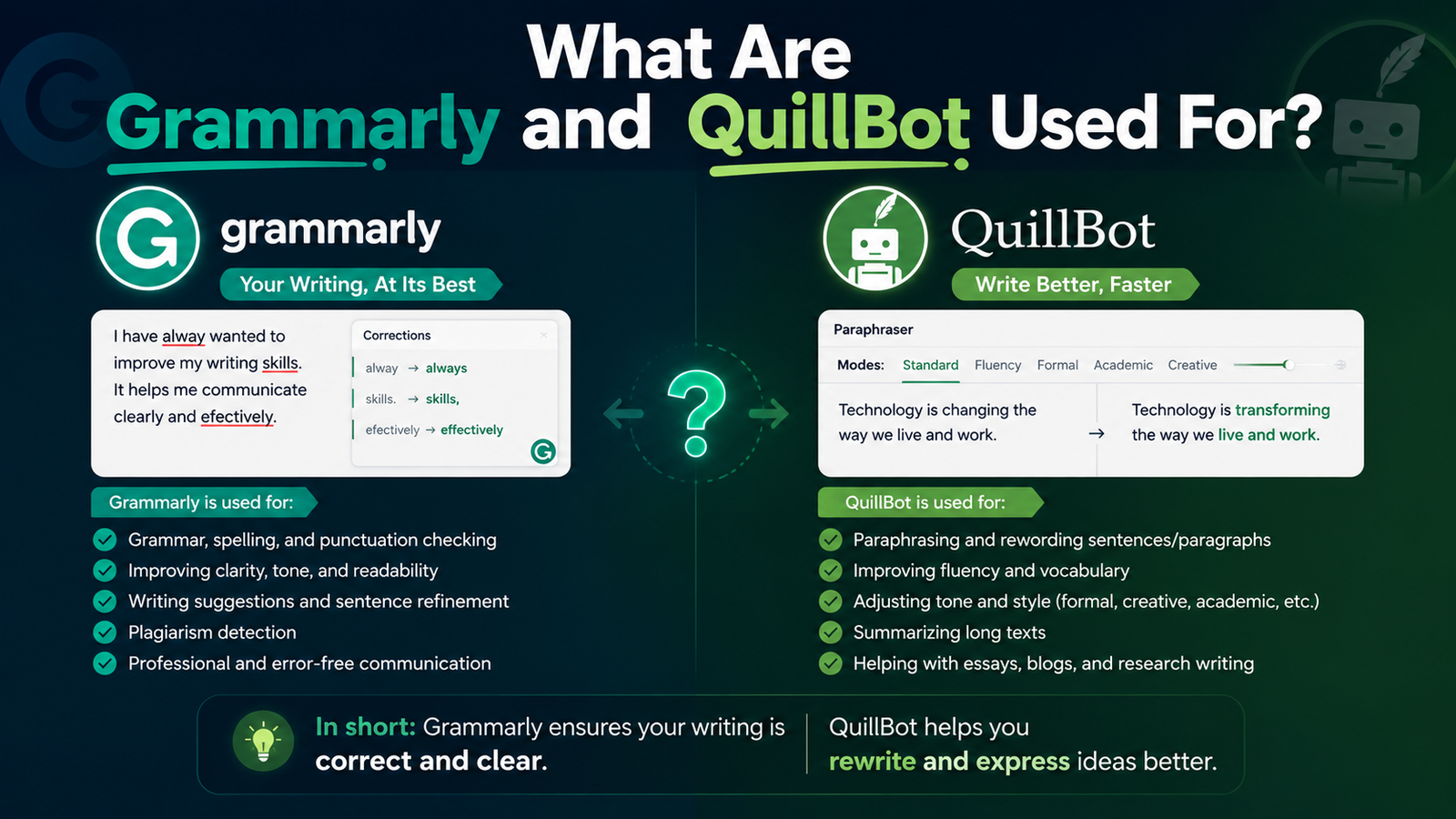
Grammarly and QuillBot are smart AI-powered writing tools that help people write better in different ways.
Grammarly is like a helpful friend that checks your writing for errors, improves clarity, and ensures it sounds just right. It helps correct mistakes as you write or send text.
QuillBot is like a rewriting tool that takes your words and rephrases them so they sound different while retaining the same meaning. It helps make your writing clearer or more concise without changing your message.
Moreover, AI-assisted writing is growing rapidly across education and business. Around 75% of knowledge workers now use AI in some form at work — Source: Microsoft Work Trend Index, 2024.
You may also like this article :- Best AI Tool for Writing Emails at Work
Why Are Writing Assistance Tools Important Today?
Writing assistance tools are essential these days because modern communication demands speed, accuracy, and professionalism.
First, businesses rely heavily on written communication. For example, professionals spend approximately 28% of their workweek reading and responding to emails — Source: McKinsey Global Institute.
Another reason is that the content creation landscape has become highly competitive. Bloggers, marketers, students, and researchers need to produce high-quality content quickly while ensuring accuracy and readability.
Furthermore, grammar-checking tools identify and correct errors in spelling, punctuation, grammar, and style, making the content clear and precise. This process helps writers express their ideas more clearly and professionally.
You may also like this article :- Best AI Tools for Small Business Owners 2026
How Does Grammarly Improve Writing Quality?
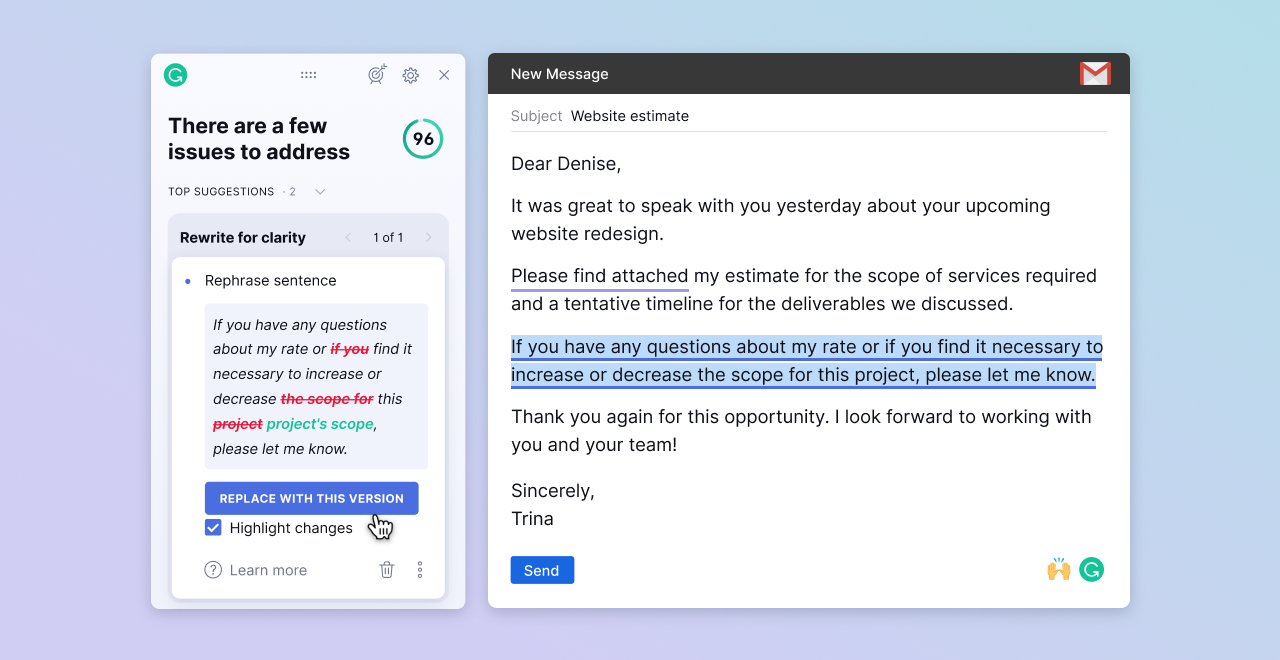
Grammarly improves the quality of your writing by identifying errors and offering suggestions to enhance grammar, clarity, tone, and style.
Grammarly Features and Strengths
First, Grammarly excels at proofreading. It checks:
- Grammar mistakes
- Spelling errors
- Punctuation issues
- Sentence clarity
- Tone consistency
For example, if you’re writing a formal business proposal or email in casual language, Grammarly may suggest more professional options to enhance the impact of your writing.
In addition, Grammarly offers AI-based writing assistance, which helps users write, create, and distribute content. This feature has made it a popular favorite among both professionals and students.
Clear writing increases reader engagement. Clear communication reduces misunderstandings, makes your message more effective, and helps your content reach more people.
Grammarly Limitations
However, Grammarly’s primary objective is not in-depth content rewriting. Although it can rewrite sentences, it does not offer advanced paraphrasing modes like QuillBot.
How Does QuillBot Help With Paraphrasing and Rewriting?
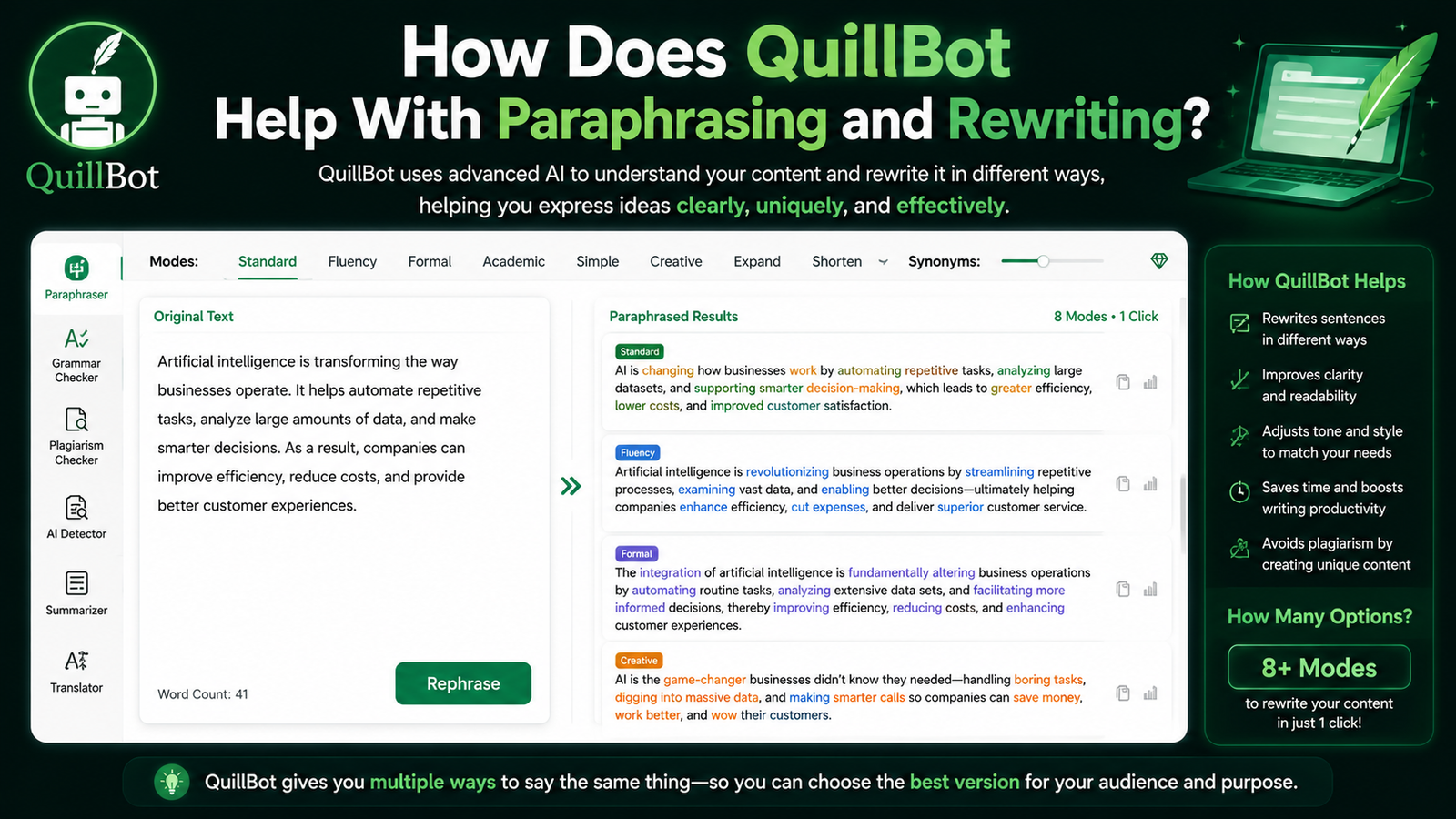
QuillBot helps users generate various versions of text to rewrite content while preserving the original meaning.
QuillBot Features and Strengths
First of all, paraphrasing means rewriting text using different words while preserving the original meaning and intent. This is QuillBot’s greatest feature.
QuillBot offers multiple rewriting modes, including:
- Standard
- Fluency
- Humanize
- Formal
- Creative
- Academic
- Simple
- Expand
For example, a student can transform a simple paragraph into a more formal one suitable for a research paper.
Additionally, QuillBot offers tools that can help shorten text, correct grammatical errors, add context, and translate languages.
Rewriting content gives writers greater flexibility. They can tailor the message to different audiences without having to rewrite everything from scratch.
QuillBot Limitations
However, compared to Grammarly, QuillBot’s grammar detection is generally less detailed. Although it identifies many errors, its primary focus remains on rewriting rather than editing.
What Are the Main Differences Between Grammarly and QuillBot?
The main difference between Grammarly and QuillBot is that Grammarly focuses on editing while QuillBot focuses on rewriting.
Feature | Grammarly | QuillBot |
Grammar Checking | Excellent | Good |
Paraphrasing | Basic | Excellent |
AI Writing Assistance | Strong | Moderate |
Summarization | Limited | Strong |
Plagiarism Detection | Available | Available |
Browser Extensions | Excellent | Good |
Free Plan | Available | Available |
Best Use Case | Editing & Proofreading | Rewriting & Paraphrasing |
Which Tool Has Better Grammar Checking Accuracy?
First of all, Grammarly is generally more effective at identifying errors related to grammar, punctuation, and style.
For example, Grammarly can detect issues regarding tone inconsistency and sentence clarity that QuillBot might overlook.
Is QuillBot Better Than Grammarly for Paraphrasing?
Yes, QuillBot is generally superior when it comes to modifying and paraphrasing content.
For example, bloggers & content creators often use QuillBot to rewrite content ideas, ensuring the material remains easy to read and original.
Grammarly is generally preferred for proofreading and editing, while QuillBot is commonly used for rewriting and paraphrasing content.
Which Tool Is Better for Students, Bloggers, and Professionals?
The better tool depends on your writing goals rather than a universal winner.
Best for Students
First of all, students generally benefit from both tools. Grammarly helps correct errors, while QuillBot assists with rewriting and summarizing.
Best for Bloggers and Content Creators
Secondly, bloggers often use QuillBot to restructure content and Grammarly for final editing.
For instance, a blogger might rewrite draft sections using QuillBot and then use Grammarly to correct any errors.
Best for Business Professionals
Additionally, professionals often prefer Grammarly because accuracy and professionalism in communication is more important than large-scale restructuring or paraphrasing.
Can Grammarly and QuillBot Be Used Together Effectively?
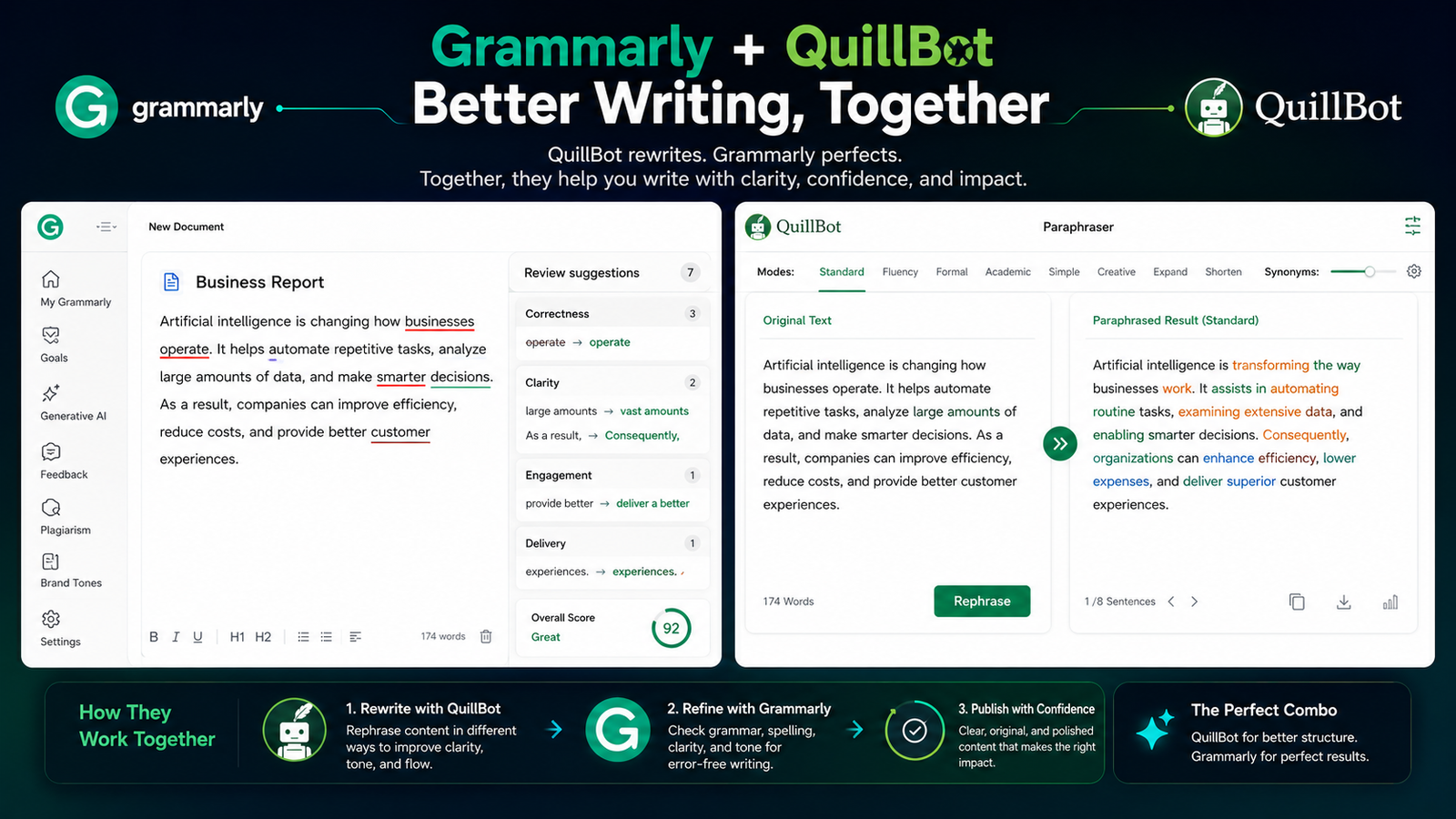
Yes of course, Grammarly and QuillBot can be used together to create a highly efficient writing workflow.
A common workflow looks like this:
- Draft content manually.
- Rewrite sections using QuillBot.
- Review mistakes, tone, sentence clarity and grammar in Grammarly.
- Perform final human editing.
For example, marketers, bloggers and content creators often use QuillBot to create alternative copy variations and Grammarly to ensure professional quality before publishing.
You may also like this article :- Best AI Tools for Office Use In 2026
What Are the Risks of Using AI Writing Tools?
Artificial Intelligence (AI) writing tools are helpful, but they should not replace human understanding.
First, sometimes AI can suggest or misinterpret the full context. For example, complex technical content requires careful human review for better accuracy.
Second, excessive reliance on AI can weaken your unique writing voice. Research from Stanford HAI highlights ongoing concerns about AI-generated inaccuracies and hallucinations — Source: Harvard Kennedy School, 2025.
Furthermore, if AI does not generate content correctly, it might inadvertently plagiarize someone else’s work. That is why human editing and verification are essential to refine the output. Human insight remains crucial to ensuring accuracy and unique content from others.
You may also like this article :- Is AI Making People Smarter or Lazy?
What Is the Future of AI-Powered Writing Assistants?
In the future, AI-powered writing will be able to better understand individual preferences and the writing process, as well as correct errors more effectively.
First, these tools will learn the various ways people write and offer suggestions tailored to your speaking or writing style.
Second, these smart assistants will integrate seamlessly with the tools people use for their work, making everything easier and faster. Gartner predicts that generative AI will influence a large portion of enterprise content creation workflows by the end of the decade — Source: Gartner, 2025.
You may also like this article :- Best Free AI Tools for Daily Productivity in 2026
Conclusion
Comparing Grammarly and QuillBot is like choosing between correcting errors and rewriting text. If your primary goal is to improve grammar, check your writing style, and make your writing clear and professional, then Grammarly is the better choice. However, if you frequently need to rephrase sentences or create summaries, QuillBot is the better option.
Many people find it beneficial to use both tools together, as this allows them to write better and faster. Before choosing one, consider which aspect of your writing you most want to improve and select the tool accordingly.
Written by: Vishal — AI Researcher & Blogger with 4+ years of experience making artificial intelligence simple, practical, and accessible for everyone.
Reviewed by: Vishal — While writing this article, The process entails verifying every fact, figure, date, and name using reliable and original sources to ensure that they are accurate.
FAQs
1. Can QuillBot completely replace Grammarly?
QuillBot is good for rewriting and paraphrasing the content, but Grammarly is better at catching errors like grammar, punctuation mistakes and improving overall writing clarity. If you want your writing to be correct, use Grammarly. If you want to rephrase sentences, use QuillBot.
2. I'm a student with a limited budget. Which tool should I choose first?
If you have to choose just one option, start with Grammarly. It helps you write almost anything from school homework and emails to stories and reports. Later on, if you frequently need to rephrase or summarize text, you can also use QuillBot.
3. Does using QuillBot for paraphrasing count as plagiarism?
Generally not, but you still need to exercise caution. QuillBot changes the wording but retains the original idea. If you are using information from books, articles, or research papers, you should give proper credit and indicate where you obtained it.
4. Which tool is better for writing professional emails and office work?
Grammarly is generally the best option. It helps make your emails polished, error-free, and well-structured. QuillBot can rephrase sentences, but if you want to avoid errors and look professional, Grammarly is better.
5. Do professional writers and bloggers use both Grammarly and QuillBot together?
Yes, many people do this. They typically use QuillBot to revise or improve the initial draft of their writing, and then use Grammarly to correct errors related to grammar, tone, and readability. Using both tools together often yields better results than using just one.
Now, It is very clear to understand the difference between Grammerly and Quillbot where we can use it according to the purpose of work through your blog
Thank you so much 👍
Pingback: Master the Perfect ChatGPT Prompt Formula