
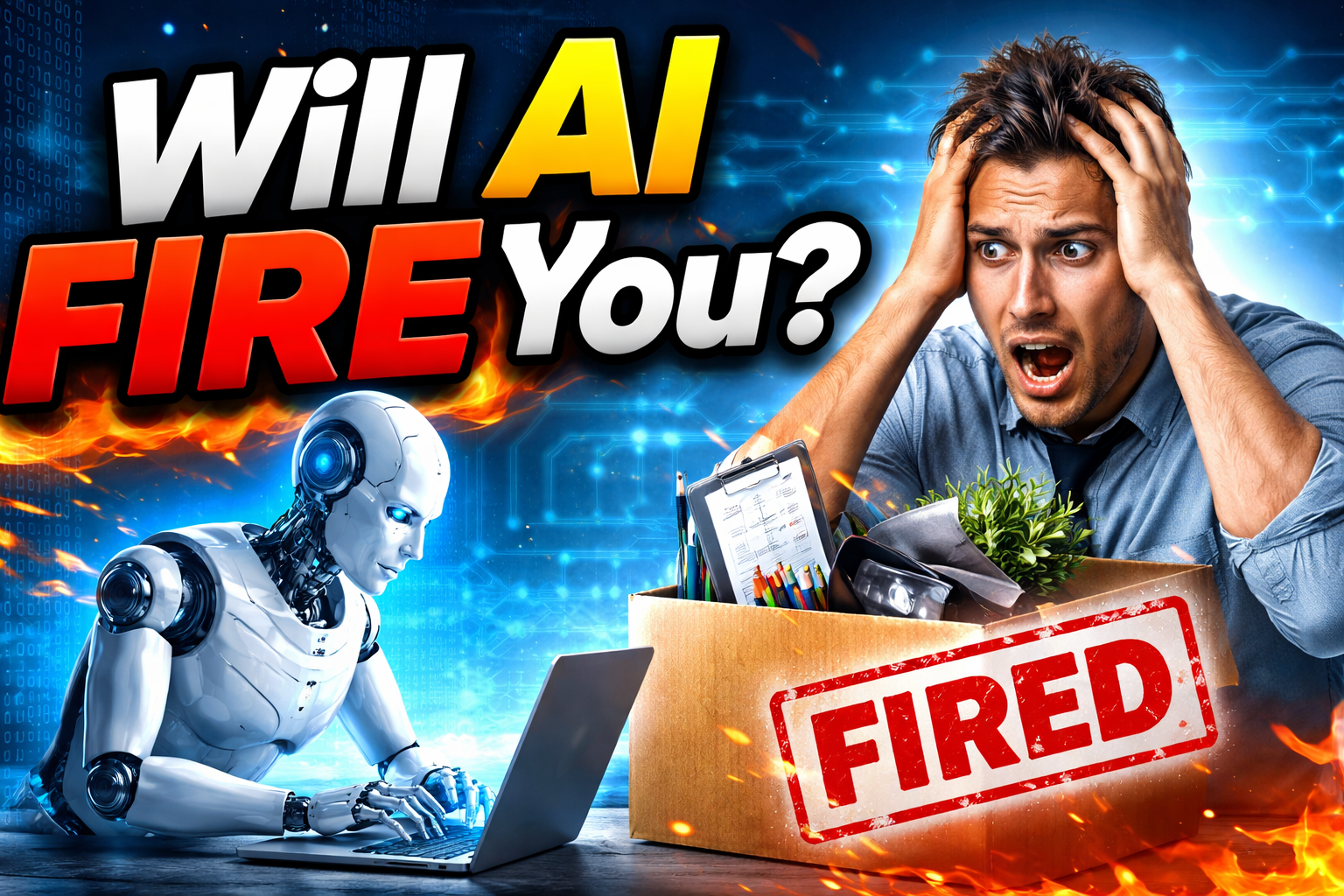
If you search online right now, you’ll see headlines like “AI will replace jobs” or “Your career is at risk.” Honestly? That kind of content creates more fear than clarity.
So let’s slow down and talk properly.
AI is changing jobs, that part is true. But it’s not happening in the dramatic, overnight way social media makes it look.
This article is written for people who:
- Know a little about AI
- Have started using AI tools casually
- Want to stay relevant, confident, and ahead in their career or personal growth
No technical jargon. No fear mongering. Just real talk.
If you’re completely new to AI, I recommend first reading our beginner guide: “What Is AI and How You Can Use It in Daily Life?” It explains AI in very simple terms and will make this article even easier to understand.
Now, let’s get into it.
Why People Are Worried About AI and Jobs
The fear around AI mostly comes from uncertainty.
People are not scared of AI itself, they’re scared of:
Losing stability
Becoming irrelevant
Not knowing what to learn next
And that fear is understandable.
But here’s an important mindset shift:
AI is not replacing people.
AI is replacing certain tasks.
Once you understand this difference, everything becomes clearer.
How Jobs Have Always Changed With Technology
This is not the first time humans have faced big technological change.
Think about:
Machines in factories
Computers in offices
The internet
Smartphones
Each time, people said:
“Jobs will disappear.”
Some jobs did disappear but many more were created or transformed.
What actually happened?
People who adapted stayed relevant
People who resisted struggled
AI is just the next step in that long journey.
What AI Is Really Changing in Jobs
AI is not coming for job titles. It’s coming for repetitive, predictable tasks.
For example:
Writing basic reports
Sorting large amounts of data
Answering common customer queries
Doing the same manual work again and again
This means:
Jobs will look different
Roles will evolve
Output expectations will increase
But humans are still needed for:
Judgment
Creativity
Decision-making
Responsibility
AI is fast. Humans are thoughtful.
The future belongs to people who can combine both.
Most Affected Jobs by AI (And What That Really Means)
Let’s be honest, some roles feel the impact of AI more quickly.
These usually include:
Data heavy roles
Highly repetitive desk jobs
Rule based work
Basic content generation tasks
But affected does not mean eliminated.
In most cases, AI:
Reduces boring work
Increases expectations
Changes skill requirements
People who learn to work with AI in these roles often become more valuable, not less.
Jobs AI Cannot Fully Replace
This is important for confidence.
AI struggles with:
Human emotions
Ethical judgment
Original creativity
Leadership
Relationship building
Decision making
Roles that depend on:
Trust
Empathy
Strategy
Vision
will always need humans.
Even in highly technical fields, AI still needs human guidance.
How AI Is Creating New Opportunities
Here’s the part that most people don’t talk about enough.
AI is creating:
New roles
Hybrid jobs
Better productivity for individuals
Opportunities for solo creators and professionals
Examples:
AI-assisted marketers
AI-powered designers
AI-aware managers
Creators producing higher quality content faster
AI lowers the barrier to entry, but raises the bar for quality.
That’s a good thing for people who care about learning.
How Students Can Stay Ahead in the AI Era
For students, the rules are changing.
Degrees still matter but skills matter more.
Students can use AI to:
Understand complex topics
Learn beyond textbooks
Practice explanations
Explore future careers
The most important skill students can build today is:
Learning how to learn
AI is not a shortcut for thinking, it’s a tool for deeper understanding when used correctly.
How Working Professionals Can Stay Relevant
If you’re already working, here’s the good news:
AI is not here to replace you, it’s here to upgrade you.
Smart professionals use AI to:
Improve output quality
Save time
Reduce mental overload
Focus on higher value work
Instead of asking:
“Will AI take my job?”
Ask:
“How can AI make me better at my job?”
That one question changes everything.
AI can help with:
- Planning routines and habits
- Making better opinions/decisions
- Travel planning
- Budgeting ideas
- Learning hobbies
- Personal productivity
- Explaining things to kids
Think of AI as:
A thinking personal assistant that helps you to organize your life and work.
How Creators & Freelancers Can Grow With AI
Creators often fear AI the most and for good reason.
But here’s the reality:
AI can generate content
But it can’t replace original perspective
Creators who win:
Use AI for brainstorming
Use AI for editing
Keep human voice and thinking
AI handles speed.
Humans handle meaning.
That combination is powerful.
Skills That Will Matter More Because of AI
As AI handles more routine work, human skills become more valuable.
These include:
Critical thinking
Clear communication
Creativity
Adaptability
Problem framing (asking good questions)
Notice something?
These are life skills, not just job skills.
AI rewards people who think, not just follow instructions.
How to Stay Ahead of AI (Practical Steps)
You don’t need to do everything at once.
Start simple:
Learn AI basics (no coding required)
Use AI regularly, not occasionally
Apply AI to real problems
Keep learning continuously
Most people fall behind not because AI is fast but because they stop learning.
Common Myths About AI and Jobs
Let’s clear a few things up.
Myth: AI will replace everyone
Truth: AI will replace repetitive or unchanging work
Myth: Only tech people will survive
Truth: Curious people will survive
Myth: It’s too late to learn AI
Truth: It’s still early
Myth: AI makes humans less important
Truth: It makes human judgment more important
Final Thoughts: AI Rewards the Curious, Not the Fearful
AI is not here to scare you. It’s here to change how work is done.
The people who stay ahead are not the smartest or youngest, they are the most curious and adaptable.
If you’re reading articles like this, learning slowly, and applying what you learn, you’re already ahead.
And if you want to build your foundation properly, don’t miss our beginner article:
“What Is AI and How You Can Use It in Daily Life?”
This blog is not about selling fear or shortcuts. It’s about helping curious minds grow, one concept at a time.
Stay curious. Stay calm.
That’s how you stay ahead.
FAQs
1. Should I be worried that AI will take my job?
Short answer: no, not in the way people usually think. AI doesn’t wake up one day and replace people. What it actually does is change how certain tasks are done. People who stay curious, learn slowly, and adapt their skills usually end up in a better position than before.
2. Which types of jobs are feeling the impact of AI the most right now?
Jobs that involve the same kind of work again and again, like repetitive data tasks or basic content work, feel AI’s impact first. But that doesn’t mean those jobs disappear overnight. In most cases, the role evolves, and people who learn to use AI inside their work stay relevant.
3. I’m a beginner & how do I even start learning AI without feeling overwhelmed?
You don’t need to “learn AI” like a subject. Start by using it. Use AI to write, plan, explain, or learn something new. The more you use it in real situations, the more confident you become. Small steps matter more than perfect knowledge.
4. What skills actually matter in an AI driven job market?
The skills that matter most are very human ones: thinking clearly, communicating well, adapting to change, and asking good questions. AI is great at speed, but humans are still responsible for judgment, creativity, and decisions.
5. Am I too late to start learning AI now?
Not at all. Most people are still at the starting line, even if they don’t admit it. If you’re reading, learning, and experimenting today, you’re already ahead of many others. Age doesn’t matter here but mindset does.
Pingback: Common AI Myths That Are Completely Wrong -