
Most people already use AI to write emails, generate ideas, summarize information, or complete work faster. But while AI makes life easier, many people are starting to wonder whether it improves human intelligence or quietly reduces independent thinking. In this guide, you’ll learn how AI affects productivity, creativity, memory, and critical thinking. Plus how to use AI without becoming dependent on it.
Key Takeaways
- Artificial intelligence improves efficiency by automating repetitive tasks and speeding up information access.
- AI productivity tools can improve learning and creativity when used as assistants instead of replacements.
- Overdependence on AI may weaken critical thinking and memory retention over time.
- Students and professionals are already using AI daily for education, coding, writing, and research.
- Responsible AI usage requires fact-checking, active learning, and independent decision-making.
- Human intelligence and AI work best together through collaboration rather than full automation.
Digital literacy and critical thinking will become essential skills in the AI era.
What Is Artificial Intelligence and How Does It Affect Daily Life?
Artificial Intelligence is a technology that enables machines to perform tasks that typically require human cognition—such as learning, decision-making, and problem-solving. Today, AI is utilized in chatbots, recommendation systems, voice assistants, search tools, writing codes and software designed to help people work more efficiently.
Artificial Intelligence has now become an integral part of our daily lives. For instance, when you ask ChatGPT to explain your notes, navigate using Google Maps, or watch your favorite shows on Netflix, AI assists you in making decisions and guiding your actions.
An increasing number of companies are beginning to incorporate AI tools into their operations. A study conducted by OpenAI and Anthropic reveals that, by utilizing these tools, many employees save approximately 40 to 60 minutes of time each day.
Source: OpenAI & Anthropic Enterprise Research, 2025
Rather than dominating our minds, Artificial Intelligence helps us perform tasks, which we are already capable of doing well—even more effectively. Individuals who are proficient in their work become even more capable with the aid of AI, whereas those who rely on it exclusively may become overly dependent on machines for every task.
You may also like this article :- Best Free AI Tools for Daily Productivity in 2026
Why Are People Worried That AI Is Making Humans Lazy?
Some people are concerned that AI is making people lazy because it performs tasks for us, thereby eliminating the need for us to think deeply or solve problems on our own. This is a significant discussion, as AI is currently transforming the way we learn, work, and create new things in every sphere.
Many students rely on AI to provide answers rather than truly understanding the underlying concepts. For example, some students copy essays generated by AI without making any attempt to write or reflect upon them themselves.
Nowadays, the use of machines and computers in jobs is steadily increasing. While this allows work to be done faster and more efficiently, it may also mean that people do not get as much practice in thinking and making decisions on their own.
A study by Microsoft and Carnegie Mellon University found that people who use AI tools extensively for their work think less carefully and less attentively about their work.
Source: Microsoft Research, 2025.
A study conducted in 2025 involving 580 college students found that those who made greater use of AI tools experienced more difficulty in thinking critically and making sound decisions.
Source: ScienceDirect, 2025.
How Cognitive Offloading Changes Thinking
“Cognitive offloading” refers to the use of technology to perform mental tasks rather than executing them manually. Artificial intelligence further accelerates this process, providing instant answers with minimal effort.
For instance, many people today seek quick solutions from AI tools instead of engaging in brainstorming themselves. While this saves time, it may reduce the effort required for creativity and could potentially impact the formation of long-term memories.
You may also like this article :- Is AI Safe to Use for Work, Study, and Personal Tasks?
How Can AI Make People Smarter and More Productive?
When we provide more people with opportunities to learn, assist with tedious tasks, and help us acquire knowledge more rapidly, Artificial Intelligence (AI) can make us more intelligent and aid in completing tasks more quickly. When utilized correctly, AI supports our thinking rather than replacing it.
First of all, finding information becomes much easier with AI. Instead of browsing through multiple websites, people can obtain a concise summary of complex topics in just a few seconds.
Secondly, AI helps employees perform their work faster and better. A study found that 75 out of 100 employees stated that AI has made their work faster or better.
Source: OpenAI & Anthropic Enterprise Research, 2025
Third, AI helps students learn in a way that is tailored to their needs. They can receive instant explanations, engaging quizzes, and personalized assistance whenever required.
Using AI to assist in completing work accelerates processes by automating tedious tasks, thereby allowing people to devote more time to significant and creative ideas.
Real-World Examples of AI Improving Productivity
AI tools for work help people complete tasks faster and produce better, more creative work.
For example:
- Programmers use specialized tools to fix errors in their code.
- Writers use AI to generate ideas and plan their stories.
- Doctors use AI to look up medical information.
- Advertisers use AI to quickly brainstorm new advertising ideas.
According to Microsoft research, 58 out of 100 people have used AI to accomplish tasks that they could not have easily done a year ago.
Source: Microsoft Workplace Signals, 2026
You may also like this article :- How AI Is Changing Jobs (And How to Stay Ahead)
Can AI Reduce Critical Thinking Skills Over Time?
When people rely excessively on AI-generated responses without critical thought or verification, their cognitive abilities may deteriorate over time. The extent of this decline depends on the frequency with which they utilize AI.
Engaging in deep reflection and problem-solving enhances an individual’s reasoning skills. Asking questions and critically evaluating information are fundamental components of sound thinking.
For example, students who mindlessly copy AI-generated answers may miss out on the opportunity for deep learning.
A 2025 study conducted by Microsoft Research revealed that over-reliance on AI leads individuals to expend less mental effort on assigned tasks.
Another study conducted in 2025 by the MDPI Society found that excessive AI usage impairs cognitive function, as individuals become overly dependent on the technology.
Why Verification Matters in the AI Era
Verifying the information provided by AI helps ensure its accuracy and reliability. This is crucial because AI can sometimes generate incorrect or outdated information.
For example, chatbots may occasionally provide factual errors or misleading summaries. If individuals blindly accept everything AI asserts without verification, they risk disseminating misinformation.
By cross-checking AI-generated responses, people engage their cognitive faculties more effectively rather than placing blind faith in the technology.
You may also like this article :- Common AI Myths That Are Completely Wrong
How Does AI Affect Students, Creativity, and Learning Habits?
Artificial Intelligence (AI) impacts students and their creativity, as it helps them learn faster while sometimes encouraging them to take shortcuts rather than thinking for themselves. The nature of this impact depends on how individuals choose to utilize this technology.
Firstly, AI facilitates learning by providing quick explanations, translations, and personalized assistance.
Secondly, AI transforms creative endeavors. Writers, designers, and artists utilize AI to brainstorm ideas, craft narratives, and develop novel concepts.
Research indicates that employing AI to aid in brainstorming can help individuals generate a greater volume of ideas and streamline creative processes – Source: Springer Nature, 2025
However, if individuals become overly reliant on AI, it can become problematic. A report by the MIT Media Lab suggests that excessive use of AI for writing tasks may hinder one’s ability to focus, exercise creativity, and retain information – Source: Phys.org, 2025
AI in Education: Benefits vs Risks
| Area | Benefits | Risks |
|---|---|---|
| Learning | Faster explanations | Reduced deep learning |
| Homework | Personalized help | Copy-paste habits |
| Creativity | Faster brainstorming | Reduced originality |
| Research | Quick summaries | Poor fact-checking |
| Memory | Easier retrieval | Lower retention |
Best AI Tools That Improve Productivity Without Replacing Thinking
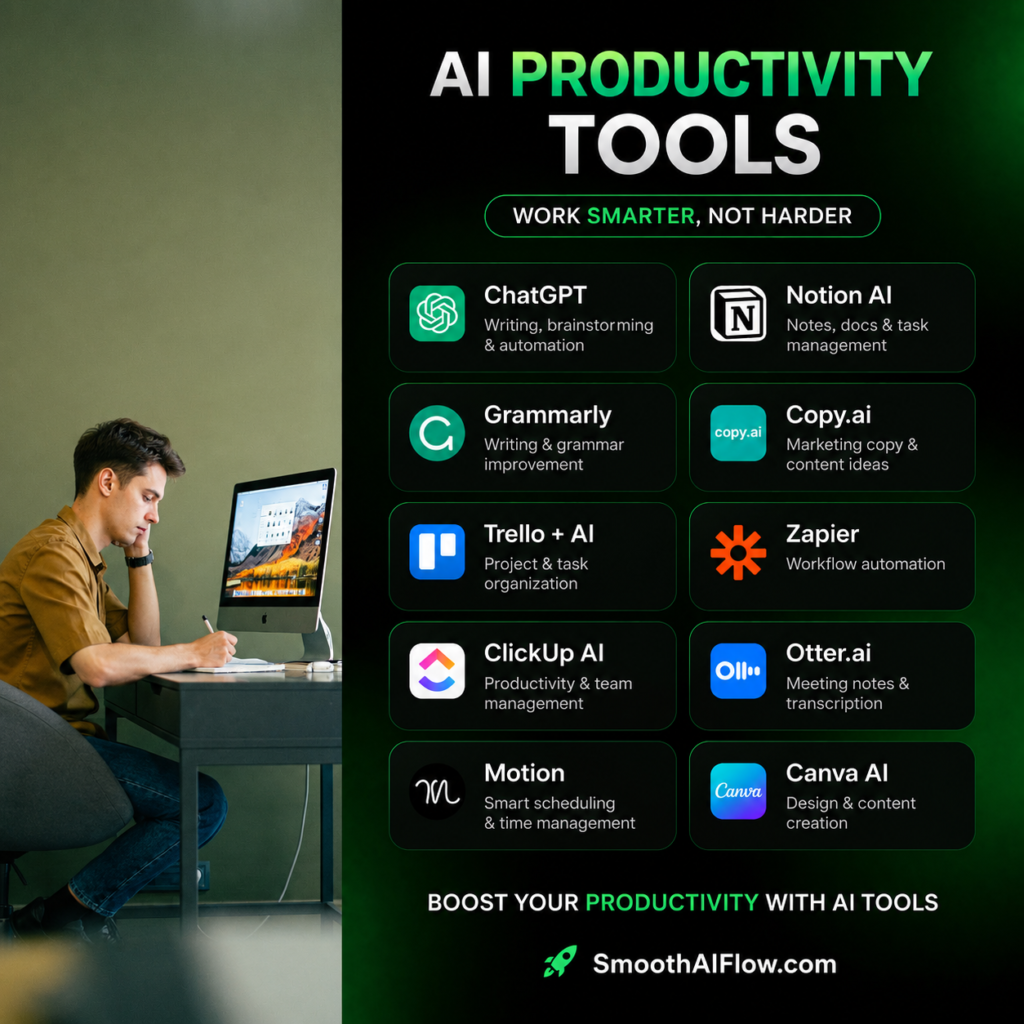
The best AI tools help people think and generate new ideas, rather than making all the decisions for them. These tools assist users in brainstorming, organizing, and learning more effectively.
Popular examples include:
- ChatGPT for brainstorming and research
- Grammarly for editing and clarity
- Notion AI for productivity workflows
- GitHub Copilot for coding assistance
- Khanmigo for AI-assisted learning
Furthermore, people should use AI in conjunction with traditional methods—such as taking notes, reading books, and conducting their own research.
You may also like this article :- How to Use AI to Save 10+ Hours Per Week at Work?
How Can You Use AI Without Becoming Overdependent?
You can incorporate AI into your work without becoming dependent on it. Rather than viewing it as a substitute for your own thinking, regard it as an assistant. If you use AI responsibly, you can integrate it with active learning, fact-checking, and human judgment.
First, brainstorm your own ideas briefly before asking AI for a response. For instance, focus on your own thoughts first, and then turn to AI to further refine and enhance them.
Second, verify critical information yourself. AI-generated content should serve to support your ideas, not replace them.
Third, regularly exercise your memory and reasoning skills through reading, writing, and problem-solving exercises.
The responsible use of AI involves integrating it with active learning, fact-checking, and human decision-making capabilities.
What Skills Will Matter Most in an AI-Driven World?
As AI continues to automate everyday tasks, distinct human skills will become even more valuable. Future success will depend on how we integrate technology with human capabilities.
In this era of AI, the most valuable skills include:
- Critical thinking
- Communication
- Creativity
- Emotional intelligence
- Decision-making
- Digital literacy
- Adaptability
Research consistently indicates that the impact of AI depends less on the technology itself and more on the behavior of the people utilizing it – Source: Science Alert, 2026
Conclusion
Artificial intelligence, in and of itself, makes people neither more intelligent nor lazier. It merely assists us in performing the tasks we are already accustomed to doing. Curious and diligent individuals accomplish more work and acquire more knowledge. However, those who are not particularly proactive may begin to develop an excessive reliance on artificial intelligence.
Studies indicate that if we utilize artificial intelligence wisely, it can facilitate our learning, foster greater creativity, and boost our productivity. Conversely, if individuals cease to think for themselves, they risk losing their problem-solving capabilities as they become overly dependent on artificial intelligence.
The most promising future belongs to those who can work proficiently by harnessing the power of both their own intellect and artificial intelligence. When we employ artificial intelligence judiciously—verifying the information it provides while continuing to think independently—we evolve into better versions of ourselves, rather than becoming more dependent.
Written by: Vishal — AI Researcher & Blogger with 4+ years of experience making artificial intelligence simple, practical, and accessible for everyone.
Reviewed by: Vishal — While writing this article, The process entails verifying every fact, figure, date, and name using reliable and original sources to ensure that they are accurate.
FAQs
1. If AI keeps doing everything for us, will people slowly stop thinking on their own?
People are concerned that if they use AI for every task, such as writing, thinking, and problem-solving—their own cognitive abilities might deteriorate. However, the problem does not lie with AI itself; rather, it lies in the way people use it. If they utilize AI to assist them, rather than relying on it for every single task, it can actually accelerate their pace of learning and thinking.
2. Is using AI for studying or office work considered cheating?
Sometimes it is effective, and sometimes it is not; it all depends on how you use it. If a student uses AI to learn difficult subjects, make notes easier to read, or practice questions, it serves as an excellent method of learning. However, if someone copies AI-generated answers verbatim without truly understanding them, it can lead to problems. The same principle applies to work in the office. AI should serve to assist you in completing your tasks more quickly, rather than taking over complete control or causing you to forget how to perform the work yourself.
3. How can I use AI daily without becoming dependent on it?
A simple habit can solve this problem. First, spend a few minutes thinking in solitude. Then, use AI to refine your ideas, check your work, or save time. For instance, start by jotting down your rough ideas, and then ask the AI to organize or refine them. This keeps your mind active while the AI makes your work even easier.
4. Are students becoming less creative because of AI tools?
This may be true for some people, but not for everyone. Some students use AI merely to obtain quick answers, which can diminish their creativity and critical thinking. Conversely, other students utilize AI to generate new ideas, learn faster, and gain a deeper understanding of concepts. AI can either foster creativity or undermine it, depending on whether individuals use it to facilitate their own thinking or rely on it blindly.
5. In the future, will people who don’t use AI fall behind others?
Yes, perhaps. AI is gradually becoming an integral part of our daily tasks, learning, and interactions with others. Those who know how to use AI wisely will likely save more time and perform their work more effectively. However, if someone relies solely on AI and fails to hone their own skills, they may encounter difficulties. The best approach is to practice a little bit of everything—learn about AI and use it intelligently, but simultaneously continue to exercise your own critical thinking and make sound decisions.
I mean wow, what a good peace of content and advice. Every point and each explanation onto the pin point. That’s why few people continuously worried about why people using AI blindly
Pingback: Grammarly vs QuillBot Which Is Better?
Well said. One thing I’d add: the timeline matters too — what looked like a failure at month three often looks like a foundation by month twelve. Context changes everything.